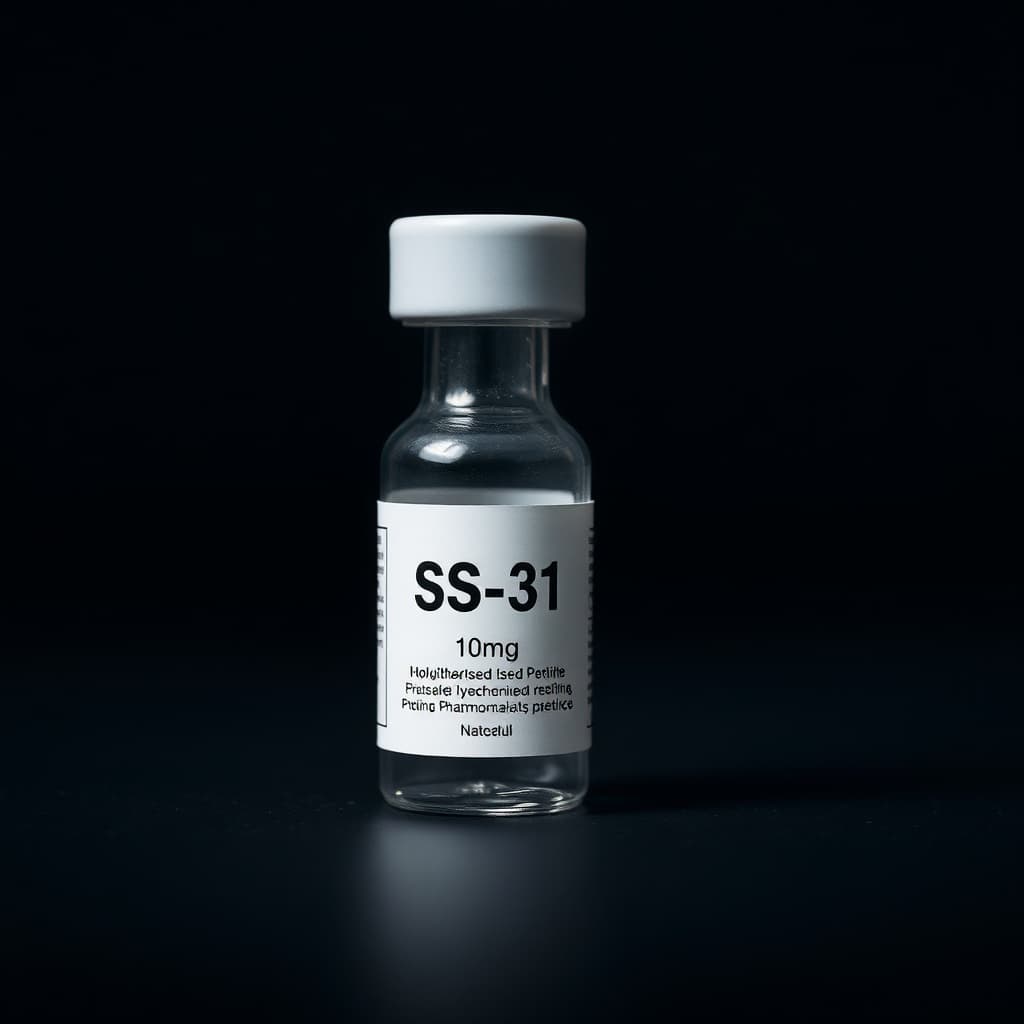
SS-31 research peptide
Mitochondrial

SS-31

Mitochondria-targeting tetrapeptide (Elamipretide) researched for cardiolipin binding and inner-membrane bioenergetics.

Purity

99%+

CAS Number

736992-21-5

Status

Made to Order

Dispatch

Same-Day (before 2pm)

Select Size

£199.99

Out of Stock

Enquire About This Peptide

Get notified when SS-31 is back in stock, or ask about availability.

Research verification required. All orders are reviewed before dispatch. You will receive an email confirmation and a WhatsApp or phone call within 60 minutes to verify your research purpose.

Third-Party CoA Included Free Delivery Over £75 Research Use Only

About SS-31

SS-31 (Elamipretide, also known as Bendavia or MTP-131) is a cell-permeable Szeto-Schiller tetrapeptide that selectively associates with cardiolipin on the inner mitochondrial membrane. It has been investigated for mitochondrial cristae stabilisation, electron-transport-chain efficiency and ischaemia-reperfusion research. Supplied lyophilised for in vitro research only.

Research Applications

Research Mechanism — SS-31

A simplified summary of what SS-31 is studied for in research models. For laboratory in-vitro use only.

Sequence:D-Arg-Dmt-Lys-Phe-NH2 (Elamipretide)

Origin: Synthetic mitochondria-targeted tetrapeptide developed from the Szeto-Schiller peptide series, designed to concentrate at the inner mitochondrial membrane.

  1. Molecular target

    SS-31 has been studied for its selective association with cardiolipin on the inner mitochondrial membrane. Binding is reported to stabilise cristae architecture and electron transport chain supercomplexes.

    • Investigated binding to cardiolipin lipid domains
    • Studied stabilisation of cytochrome c–cardiolipin complex
    • Probed interactions with ANT (adenine nucleotide translocator)
  2. Investigated pathways

    Preclinical research describes SS-31 as a modulator of mitochondrial bioenergetics and reactive oxygen species handling. Effects on apoptotic gating have also been characterised.

    • ETC complex I–IV electron flow and ATP synthesis
    • Mitochondrial ROS and lipid peroxidation attenuation
    • mPTP (permeability transition pore) opening thresholds
  3. Preclinical research applications

    Deployed in laboratory models of ischaemia-reperfusion, mitochondrial myopathy, and age-related bioenergetic decline. Not approved for human use.

    • Cardiac ischaemia-reperfusion rodent research models
    • Skeletal muscle mitochondrial dysfunction studies
    • In vitro renal tubular cell oxidative stress assays

For research use only. SS-31 is not approved as a medicine in the UK and is not intended for human or veterinary administration. See the compliance page for full terms.

Technical Specifications

Compound NameSS-31
CategoryMitochondrial
CAS Number736992-21-5
Molecular Weight639.79 g/mol
Molecular FormulaC₃₂H₄₉N₉O₅
SequenceD-Arg-Dmt-Lys-Phe-NH₂ (Elamipretide; Bendavia)
Purity≥99%+ (HPLC)
FormLyophilised powder
StorageStore lyophilised at -20°C. Protect from light. Reconstituted: aliquot and store at -80°C. Use within 30 days of reconstitution.
ReconstitutionReconstitute in bacteriostatic or sterile water. Typical stock concentration: 1 mg/mL.

Certificate of Analysis

Every order of SS-31 includes a batch-specific CoA with HPLC chromatogram, mass spectrometry data, and laboratory accreditation details.

View Sample CoA

SS-31 — Frequently Asked Questions

What is SS-31?

SS-31 (Elamipretide) is a mitochondria-targeting Szeto-Schiller tetrapeptide studied in laboratory research for its association with cardiolipin binding, inner-membrane stabilisation and mitochondrial bioenergetics. It is supplied for in vitro research only.

What purity is your SS-31?

99%+, confirmed by independent third-party HPLC analysis. Batch-specific CoA included.

Is SS-31 approved for human use?

No. Supplied for in vitro laboratory research only. Not a licensed medicine.

SS-31 is supplied by Premio Peptides (BELL RED LIMITED) exclusively for in vitro laboratory research. It is not a licensed medicine, is not approved for human or veterinary use, and must not be administered to any living organism outside a formally approved research protocol. Purchasers assume full responsibility for compliance with applicable regulations.

Related Compounds